
Defer Taxes. Build Wealth. Upgrade Your Portfolio.
Discover how a 1031 Exchange can help you sell an investment property, reinvest the proceeds, and defer capital gains taxes — legally and strategically. Schedule a Free ConsultationLearn About DST OptionsWhat is a 1031 Exchange?

A 1031 Exchange, often called a like-kind exchange, is a provision in the U.S. Internal Revenue Code (Section 1031) that allows real estate investors to defer paying capital gains tax when they sell an investment property and reinvest the proceeds into another qualifying property.
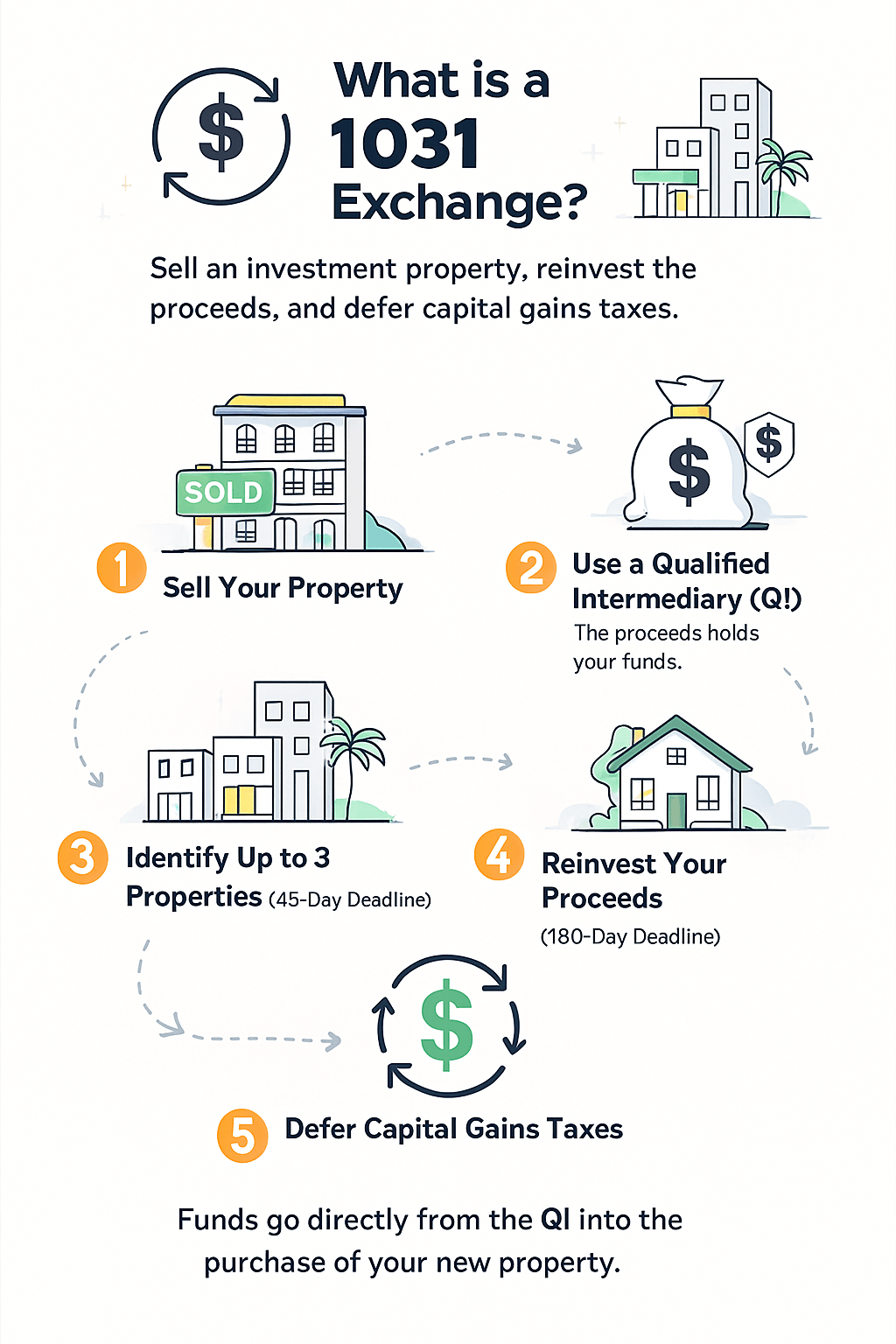
1031 Exchange – Explained in More Detail
What is a 1031 Exchange?
A 1031 Exchange, also known as a like-kind exchange, allows you to sell an investment or business-use property and reinvest the proceeds into another investment property — without paying capital gains taxes at the time of the sale.
This IRS-approved strategy helps you keep more equity working for you so you can grow your real estate wealth faster and smarter.
How a 1031 Exchange Works (Simple Steps)
Step 1: Sell Your Investment Property
The property must be held for investment or business use (not your primary residence).
Step 2: Use a Qualified Intermediary (QI)
A third-party holds your funds so you don’t receive the money directly.
Step 3: Identify Your Replacement Property (45 Days)
You can identify up to three properties—or more under special rules.
Step 4: Complete the Purchase (180 Days)
You must close on the new property within 180 days of the sale.
Step 5: Defer Capital Gains Taxes
As long as rules are followed, you defer taxes and roll all of your equity forward.
What Counts as “Like-Kind”?
“Like-kind” doesn’t mean the properties need to be the same type.
Examples of qualifying exchanges:
-
Condo → Single-family rental
-
Residential rental → Commercial property
-
Land → Apartment building
-
Office building → Warehouse
As long as both are for investment or business use, they typically qualify.
Benefits of a 1031 Exchange
Why Investors in Hawai‘i Use It
-
Defer capital gains taxes (potentially hundreds of thousands saved)
-
Increase cash flow
-
Upgrade to a better-performing property
-
Consolidate or diversify your portfolio
-
Move from active to passive investing (DST option)
-
Build long-term generational wealth
⭐ A 1031 Exchange is one of the most powerful wealth-building tools available to real estate investors.
Problems a 1031 Exchange Solves
-
Want to sell but worried about the tax hit
-
Tired of being a landlord
-
Want to retire from property management
-
Need to diversify into safer or out-of-state investments
-
Want to transition into passive income opportunities
Limits & Important Rules
To qualify, you must follow IRS rules:
-
Property must be investment or business-use
-
Must use a Qualified Intermediary (QI)
-
No touching the proceeds (must go to the QI)
-
Identification within 45 days / closing within 180 days
-
Must reinvest full proceeds & take on equal or greater debt to defer 100%
IMPORTANT:
Always consult with your tax advisor or attorney. Team Lally coordinates, but does not provide tax or legal advice.
1031 Exchange vs DST (Delaware Statutory Trust)
Many investors choose a DST when:
-
They want passive income
-
They no longer want to manage tenants, toilets, or repairs
-
They want institutional-grade real estate (multifamily, industrial, medical, storage, etc.)
-
They need a backup option if their 1031 deadlines are tight
Learn How a DST Can Work for You → What is a DST
Is a 1031 Exchange Right for You?
It may be a good fit if you:
-
Own an investment property in Hawai‘i
-
Want to sell without taking a tax hit
-
Want to upgrade, diversify, or go passive
-
Want to build long-term wealth and protect more equity
Team Lally has helped hundreds of Hawai‘i property owners understand their options.
📞 Get a Free 1031 Exchange Strategy Session
Talk with our experienced real estate team to review your goals, your current property, and the strategies available to you — including 1031 Exchange and DST options.