What is a Delaware Statutory Trust?
“I just sold a rental I owned for 20 years, bought for $80,000, and sold for $230,000”
– Adrienne Lally
Charles Jensen of Inland Securities Corporation explains what a Delaware Statutory Trust (DST) is, how it works inside a 1031 exchange, and what it actually costs you in control and liquidity.
Adrienne Lally and Attilio Leonardi also walk through the $500,000 strip mall investment they lost to fraud — and what they would have done instead.
A DST is an investment vehicle approved by the IRS under Revenue Ruling 2004-86. It lets up to 500 investors co-own institutional-grade real estate and qualifies as replacement property for a 1031 exchange.
You collect monthly distributions, the sponsor handles management, and the debt is non-recourse, so there is no credit check and no personal liability.
📣 CALLING ALL TIRED LANDLORDS! 🏠
Are you exhausted from dealing with:
🔧 Repairs
🏚️ Vacancies
⚖️ Evictions
And the constant headaches of managing investment properties?
There is a solution.
🏢DISCOVER DSTs (DELAWARE STATUTORY TRUSTS)
✅ Eliminate Landlord Responsibilities
💰 Generate Passive Income
📉 Defer Taxes with a 1031 Exchange
🏗️ Invest in Institutional-Quality Real Estate
Enjoy the Benefits of Passive Investing!
🥩MORTON’S STEAK HOUSE – View Map
Tuesday, August 18th, 2026
11:00AM – 1:00PM
— RSVP REQUIRED —
RSVP: [email protected] or call 808-212-9188



What is a Delaware Statutory Trust (DST)?

A Delaware statutory trust (DST) permits fractional ownership where multiple investors can share ownership in a single property or a portfolio of properties, which qualifies as replacement property as part of an investor’s 1031 exchange transaction. A DST takes all decision-making out of the hands of investors and places it into the hands of an experienced sponsor-affiliated trustee.
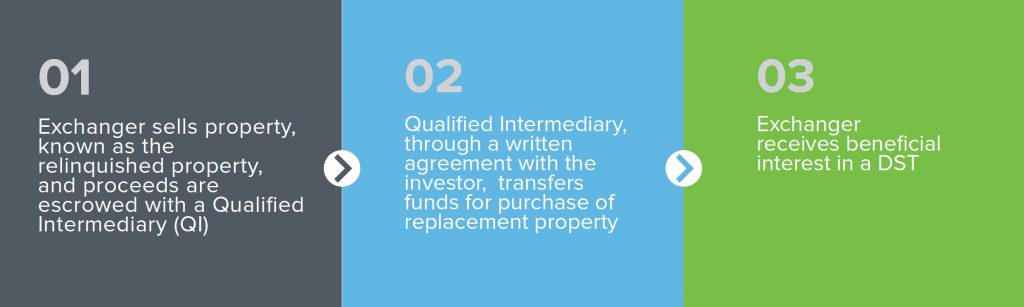
A typical 1031 exchange involving the eventual investment into a DST has three basic steps:
Key Benefits of DST 1031 Exchanges
NO MANAGEMENT RESPONSIBILITIES
The DST is the single owner and agile decision maker on behalf of investors.
LIMITED PERSONAL LIABILITY
Loans are nonrecourse to the investor. The DST is the sole borrower.
DIVERSIFICATION
Investors can divide their investment among multiple DSTs, for a more diversified real estate portfolio.
INSURANCE POLICY
If for some reason the investor can’t acquire the original property they identified, a secondary DST option allows them to meet the exchange deadlines and defer the capital gains tax.
SWAP UNTIL YOU DROP
The DST structure allows the investor to exchange real properties over and over again until the investor’s death.
ACCESS TO INSTITUTIONAL-QUALITY PROPERTY
DSTs allow investors to acquire partial ownership in properties that otherwise would be out-of-reach.
LOWER MINIMUM INVESTMENTS
DSTs accommodate much lower minimum investments. 1031 exchange minimums often are $100,000.
ESTATE PLANNING
All 1031 exchange investments receive a step-up in cost basis so your heirs will not inherit capital gain liabilities.
A DST portfolio can make inheritance easier for heirs by providing passive income without the responsibilities of directly managing a property. Ownership can be split according to the trust, allowing heirs to go their separate ways without having to agree on managing or selling the property.
ELIMINATE BOOT
Any remaining profit on the sale of your relinquished property is considered “boot.” The excess cash (boot) can be invested in a DST to avoid incurring tax.