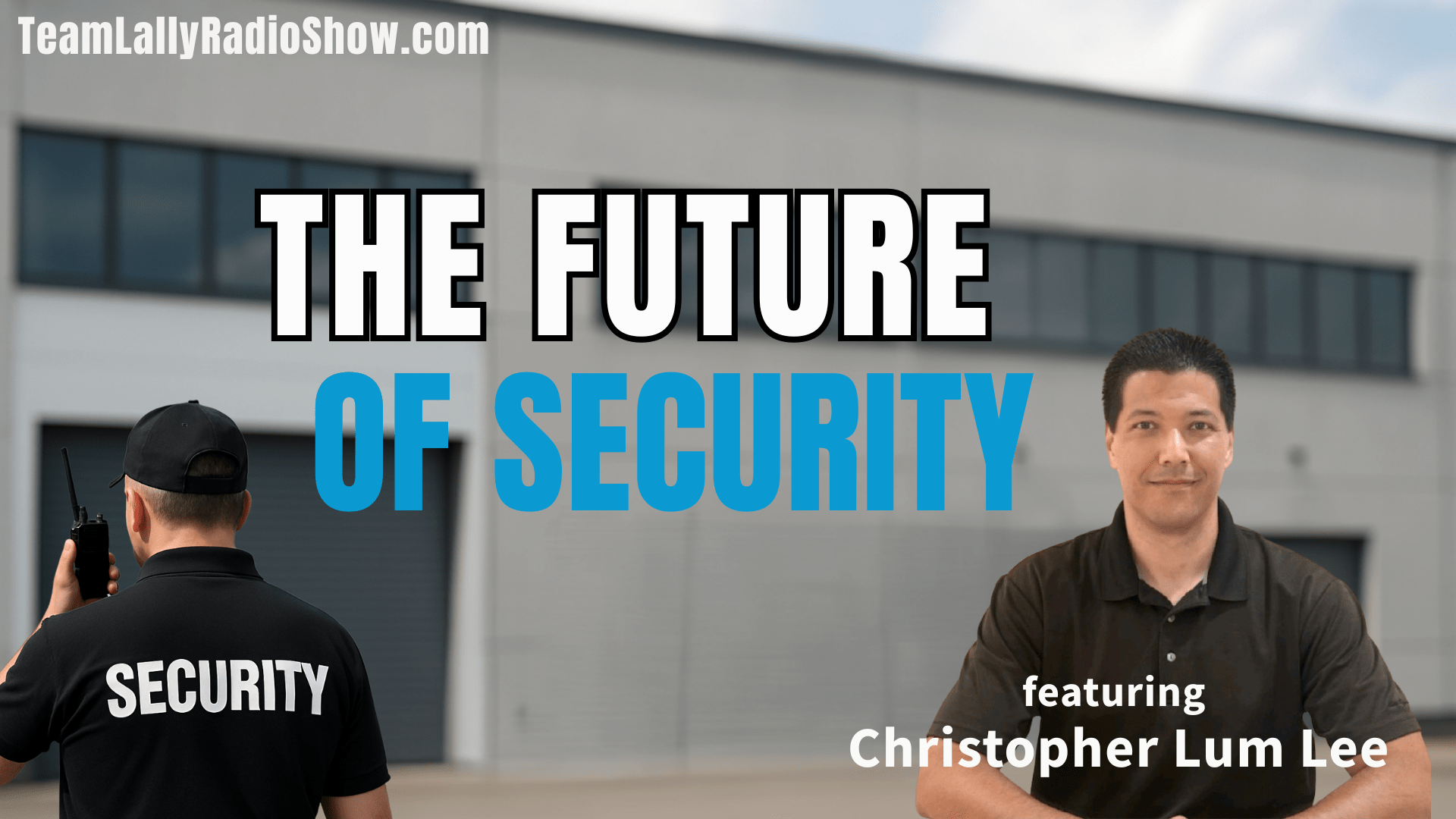

This week on the Team Lally Real Estate Radio Show, we interview Christopher Lum Lee, founder of TriSec, Inc. He shares his journey from side work in security to building a company, and what he sees ahead for Hawaii’s security industry. From the rising need for guards and spot-check patrols, to the growing role of risk analysis, disaster planning, and even cybersecurity, Christopher explains why demand is shifting and how collaboration has shaped his success.
Randy Antonio of KW Maui shares why now may be the bottom of the Maui condo market and where investors should look, while Dean Otto of Cohana Homes introduces co-ownership as a smart alternative to vacation rentals—with the flexibility to exchange stays around the world.
Watch or Listen to the full episode
Ready To Find Out How Much Your Home Is Worth?
Christopher was born and raised in Honolulu, spending much of his childhood in Pearl City before moving to town. He graduated from Damien Memorial School, earned his BA from UH West Oʻahu, and later completed his MBA at Chaminade University. With nearly a decade of experience in the security guard industry, Christopher founded his own company after recognizing an opportunity when a contract was at risk of cancellation. Beyond his business, he serves the community as the Chair of the City’s Workforce Development Board and as a member of the State’s Hawaii Correctional Industries Advisory Committee, where he helps advance workforce development, including for incarcerated individuals. His leadership reflects both entrepreneurial drive and a commitment to service.
TriSec, Inc., which Christopher incorporated in 2022, began as a security guard service and has steadily expanded its offerings. By 2023, the company added security guard training to help individuals meet state licensing requirements, and later diversified into investments such as bonds, stocks, and private money lending for local real estate projects. More recently, TriSec began offering disaster recovery and business continuity planning consulting. While security guard services remain its primary revenue source, the company has found strong footing in training and investment ventures. Guided by a balance of business growth and community impact, TriSec also contributes philanthropically, supporting local animal shelters and other causes across Hawaiʻi.
To reach Christopher Lum Lee, you may contact him in the following ways:
Phone: 808-927-3484
Email: [email protected]
Interview Transcription
ADRIENNE:
Welcome back, and thanks for listening to the team Lally real estate show, home of the guaranteed sold program, or we’ll buy it. I’m Adrienne and I’m still Attillio, and if you have any questions, just give us a call at 7999596, or check us out online at Team lally.com.
ATTILIO:
Hey, before we bring on our guests, I want to do a shout out to Hey Lonnie tengan and Tanya Madera. They are the CO owners of short stack, and that’s where I got this hat if you guys are watching us on online. And what does a hat say? Adrienne says, aloha is dope. Aloha is dope. Anyway, if you want some cool local gear, go to their shop in the pearl ridge. There was it uptown, and they just had their grand opening like couple weeks ago. Alrighty. Our guest today is Honolulu, born entrepreneur and community leader. After nearly a decade in the security guard industry, he founded his own company and grew it by seizing opportunities and expanding services. A proud graduate of Damien Memorial, u h West Oahu and Chaminade University, he brings both education and experience to his leadership.
ADRIENNE:
He also serves as chair of the city’s Workforce Development Board and sits on the state’s Hawaii Correctional Industries Advisory Committee, helping create opportunities for local workforce. Please welcome our guest. Christopher Lum Lee, all right.
ATTILIO:
Hey, Christopher, welcome.
CHRISTOPHER:
Hey, great. Great to be with you. Thanks for having me.
ATTILIO:
Yeah, you know, I don’t know if you remember, but I know we met at a networking event because I remember meeting you. I just don’t know which networking event I said, Hey, let’s talk about your business on our show. And here we are. So we got questions for you. You ready? Yes, sir. Okay, okay. So here’s our first question. What do you think is the outlook? Well, how did you get into this business real quick? I know it’s like not on the list of questions, but how did you get into
CHRISTOPHER:
this business first? So, you know, some years back, I had a day job, and then I’m one of those people that doesn’t like to have free time, so I ended up, you know, taking on a second job, doing security, because it’s, it’s not, it’s not always entirely the most difficult of work, but it’s also, you know, depending on your job site and things like that. So spent something like 10 years, or something like that at that job site, and then, and then eventually, the company that I was with at the time was going to cancel the contract, and then, and then I incorporated, got the licenses, and then took over the contract. Cool.
ATTILIO:
Yeah. So you were, you were, you were an employee that had an entrepreneurial heart. That was it. So, yeah, yeah. And then, you know, I mean, and then let’s talk about this, because everybody has perceptions of security guards is, what’s his name, Paul Blart, and it’s, it’s, it’s, I mean, that’s a humorous interpretation of it, but, um, you have the more serious part of it in that. So with that, then we’ll lead into our regular question. What do you think is the outlook for the security guard industry here in Hawaii?
CHRISTOPHER:
I think the demand is always going to be there to a degree. Demand is probably going to increase, I suspect, especially with the now that we have kind of more of the community concerns that we didn’t have 1015, years ago, things like interactions with homeless people increase with more youth gang related types of crimes, and on top of your normal property crimes and your crimes against persons, so I think The demand is going to be there on the security side, on the physical security side, but there’s also an in there’s also little pockets or sub areas where a demand will increase as well. So for example, a lot of properties can’t afford to pay for a 24 hour security guard or an eight hour security guard. So they do what are called spot checks, where security companies will go to different locations throughout the shifts and then check the location make sure that everything is fine. Yeah, and then there. And then on top of that, there are other areas as well. Now, when we look at security risk analysis, threat assessments, things like business continuity planning and disaster recovery, cyber security is kind of a big one, that there is a bridge forming between those two. So I do think the outlook is there, not only on the entrepreneur side, but also on the workforce development side.
ATTILIO:
So probably answered part of this.
ADRIENNE:
But yeah. So where are the opportunities in the security. Card Industry, yeah, if you want to expand any more that you want to touch on, because you could kind of get into that.
CHRISTOPHER:
Yeah, I think the spot checks are probably the best opportunity, just because, like I said, a lot of businesses organizations can’t afford to have a full time guard assigned there. So there’s definitely those opportunities there now for the security companies, because each spot check itself is not the most revenue generating. It improves the security companies to try to get multiple, as many of those as they can, to try to really affect the profitability of that. Yeah, I do think the disaster recovery in the business continuity side is also very interesting space, just because, you know, there are more environmental concerns and to really ramp up a lot of the utility of security guards, because those are areas that, to a degree we have to know when we do the security guard trainings, and for everyone who has to get licensed in the state, is that they have to know at least a little bit about the emergency preparedness and and things like that.
ATTILIO:
You know, Could you, could you unpack disaster relief a little bit for us? What does that mean? Sure.
CHRISTOPHER:
So a lot of, a lot of businesses, right? Don’t really consider the possibility, what happens if there’s a major disruption with some type of, some type of, it doesn’t have to be a disaster, but just general emergencies, right? So we’re familiar, we’re most familiar with things like hurricanes, floods, yeah, power outages. But then there are other things, right, like cyber attacks. There’s we had the tsunami threat recently, in back in 2020 there was the lockdowns and things like that. So a lot of businesses weren’t ready for that, and that put a lot of them at substantial risk, because they did not think of what happens if you don’t have the revenue coming in from your your daily flow of customers, but at the same time. You know, rent is probably going to be due. You know, you have to pay, possibly state unemployment insurance still on wages. So there are those types of things to consider. So from a security perspective, it’d be, you know, it’s good for the security companies to consider the possibility that expanding services to include things like business continuity planning or disaster recovery, yeah, not only helps protect the clients and their employees, but also helps the businesses recover more, at least plan ahead to be able to recover from those types of emergencies.
ATTILIO:
Now, part B on that, you talked about the expanding utility of the security guards. What does that? What tell us more about that?
CHRISTOPHER:
What do you mean by utility? Sure. So the the the traditional role of security really, was to find issues on the properties, depending on your property type, of course, but yeah, they’ll typically report on things like, you know, broken windows, unlocked doors bad actors committing vandalism on the property, things like that. Yeah, so now it’s we’ve gotten kind of to a point I think, where more clients or organizations and facilities need more services. So to expand the utility of guards would, probably would include upskilling, more training to provide more more services to the clients.
ADRIENNE:
Yeah, so, Chris, you mentioned licensing. I didn’t realize that security guards needed to have this like licensing or special training,
ATTILIO:
or did we hear that correctly? Yeah. Licensing. What does that look like, besides driver’s license so they can get to the job site, right?
CHRISTOPHER:
So prior to about, maybe about 14 years ago, give or take something like that, the only security related licenses you had to have in the state of Hawaii is you had to all security companies had to have a guard agency license, and then they had to have somebody that’s called a principal guard, who would be like the key manager, or the overseer of the employees and in the company. And then security guard themselves did not have a license. Back in the early 2010s the legislature created a law that said that everybody in the state of Hawaii who is acting, what they call acting in a guard capacity, which are security guards, had to have a particular, specific license issued by Department of Commerce and Consumer Affairs. Gotcha.
ATTILIO:
So dccna, just like us in the real estate industry, your principal guard is what we would call our principal broker, and they are responsible for all activities of people who have their license hung with them, known or unknown. And then And then, now, US realtors, we have a license. And so same thing is happening, and you just being licensed and regulated. You know, enforcement, we know as Rico and all that good
ADRIENNE:
stuff. Chris with the shortage. In the police force, yeah, do you find that, like, there’s like, a higher demand for security since, like, there’s just less police out. What have you seen or noticed with that?
CHRISTOPHER:
Yeah, the demand for guards themselves have increased. But I think the while the demand for guards has increased, the demand for for certain skill sets has also increased, yeah, because, because there’s less police officers, response time is very likely to be affected. So for security guards who are public facing and interact with people from various sites and spectrums, is that they need certain skills to be able to do things like de escalate situations, yeah, be able to provide more risk to accommodate that response time from police,
ATTILIO:
yeah, yeah. I think that’s how we how we respond or react in a situation. I know my personal experience, I was hired, I believe I’m I’m like 510 170 pounds. I’m a skinny guy. I’m not your six to 240 guy, and I was hired as a bouncer for Studebakers in the mainland. And they were like, Why are you hiring me? Because it’s because the with the training and maybe my physicality, I’m more likely to talk the situation down then throw, you know, throw the blows, which creates more liability and never ends well. So what you’re doing is just creating more de escalation training with these, with the People’s because they’re coming into high conflict situations, and their ability to handle that probably is good risk management and less liability if a guards having that type of positive interaction, de escalating, then having to go, you Know, DEF CON 11 on the people and and then waiting for the police to show up and all of
ADRIENNE:
that. So Chris, are you guys? Are you guys hiring? Are you hiring? Are you looking for more people, for your workforce,
CHRISTOPHER:
for my side, not for our side, right now, we’re fully staffed, good, but certainly all the other security guard agencies out there that I interact with, yeah, they’re all, they’re all hiring. There’s, there’s a great demand for for guards, but I think, and sorry if I’m gonna go run a little long in this response, but I think what a lot of people who get in the industry don’t realize is that there is opportunity. You know, when we talk about expanding services, also that a lot of the people who are running these security guard agencies now, they were guards, you know, years back, yes, so a lot of these guys had worked, a lot of us had worked together, and we’d come up, and then ended up starting our own, our own businesses. So, you know, there was that opportunity there.
ATTILIO:
What I noticed is new I was, I was a Wells Fargo security guard in college. I was a terrible guard, because I was, like, full time day job, overnight security guard. I’m like, I didn’t sleep for like, three days in a row. I was, like, in not the most alert guy. I was Paul, more Paul Bart than then, then actual security guard. But what? What technology or what are the things in place to to to help you manage the quality of the village. Village diligence, village vigilance. I’m having a hard time with that word. That’s that’s an indication I was a terrible security guard. What systems or processes do you have in place to get these guards more vigilant in their, whatever, in their in there on the job site
CHRISTOPHER:
for our for our site, for our clients, we’re pretty we’re pretty lucky in the sense that certain client requirements don’t, or there aren’t certain requirements that other properties will have. So ours is very, very basic in that, you know, as long as we keep track of the situations on our site, yeah, because you know where we’re at, we’re kind of responsible for watching particular equipment, making sure that it doesn’t break down, or certain alarms and things like that. Yeah, another client, we act when we go over there, we have to do things like disarm the alarms when we get there, turn the alarms back on make sure their equipment is functional and things like that. So so that equipment relies on our checking it. If the equipment goes down, then we know that somebody wasn’t doing something. Now, other sites, other security companies, they will have things like in the olden days, I don’t know if they still use this, but they had those scan buttons. You had to go to each button and scan the button, and then they would download the data, timestamp that, yeah, right. So there’s there, and there’s different variations of that. Now is my understanding that’s kind of come up as technologies and evolved
ATTILIO:
with what is your last question for you and because we go so quickly on, these shows, what, what is your what is the actually, I’m going to give the second to last one, and you give them the last question there. But my question for you to help come from contribution for you as a business owner, what is your ideal client? Look like? Not like brown hair, blue eyes and five feet, 10 and 100 seat like? What kind of business? What? On a job site, like, what is your ideal customer look like for you. For ours,
CHRISTOPHER:
we we like, we like industrial facilities, okay, because, because there’s more equipment, there’s more machinery. So it’s easier for us to to to ensure the accountability of making sure that our that our employees are actually checking those, those things, yeah, are the areas that we’ve targeted for our client, or as far as our clients are located, yeah, they’re kind of out of the, kind of out of the way in the industrial areas, Jamestown, yep, gambler area. So send Island. There’s not, right? So there’s not, there’s not much public interaction, which limits our which limits our legal liability, right? Because if you have, if you have, if you’re public facing, then you run the risk of things
ATTILIO:
like interactions with human beings,
CHRISTOPHER:
that, and there’s also, if there’s people around, depending on your location, you’ll have things like, you support situations you may, you know, I would not want to take a, I’m not inclined to take a client in white key, for example,
ATTILIO:
yeah, okay, gotcha, yeah, yeah. After two o’clock in the morning, you got all the personnel, the liquid personalities, all come out, right? Yeah. And it just, they know, they know that, that that’s, you know? I mean, I don’t know if it’s true, but it also statistically, with full moons, the human being seems to go a little nutty on full moons, more emergency room visits, etc. Adrienne, last question, last question,
ADRIENNE:
what is your favorite lesson in business and life?
CHRISTOPHER:
Yeah, collaboration. Definitely. Collaboration. You know, a lot of people will say relationships. I kind of elevate that to the business equivalent, which is collaboration within, within our own industry, we have a lot of people collaborating. Like, if we can’t take on clients, will refer them to somebody that that we have a relationship with. I work, I work with some of the other security companies on on guard trainings and things like that. So, you know, we try to help each other out as much as we can, because a lot of other industries do that. So it’s not even though we are competitors to a degree, we’re not out there trying to actively undercut each other or or do things like that.
ADRIENNE:
Yeah, we call
ATTILIO:
it coopetition competition. But Chris, I think you’re gonna like this. It’s one of my favorite quotes. It’s an African proverb, if you want to go fast, go by yourself. If you want to go far, go together, you can totally rip that off. Give me royalties on the first mention, 25 cents. All uses thereafter are completely free. I lied when I said that was the last question. One, last one. Try. Sec, T, R, i, s, e, sec, that’s the name of your company. Tri sec. Tri sec, I’m saying it a bunch of times so people can Google you and call you and get your service. How did you come up with that name for your company?
CHRISTOPHER:
Um, oh, I think so. When we first started, we had the idea we were going to try to do three different services. Yeah, right. Okay. We’re gonna start with Guard service patrols, and then Guard training, and then, of course, the business, we did a whole bunch of pivots, so now we’re doing that and some other stuff, right?
ATTILIO:
So instead of, like, the three different things, you just focus on industrial, right?
CHRISTOPHER:
So yeah, we do the security, and then on top of that, we do other types of things with our business just to try to generate additional revenue
ATTILIO:
for it. Okay? So if the rock comes in, you’re not providing private security for the rock, and the rock is kind of his own security anyway, but you guys not doing like executive security and all that stuff.
CHRISTOPHER:
We don’t we, yeah, we don’t do personal protection or executive protection.
ATTILIO:
Gotcha, gotcha. So I’m sorry, Rocky, can I hire Chris and his crew? Hire one of his you have unless you own industrial property in James Campbell or something, and you want them to keep checking on it to make sure it’s operational. But that’s it. You know, Chris, any questions we should ask you that we haven’t any funny stories. Anything you want to say, dad joke, whatever. What you got for us right before we finish?
CHRISTOPHER:
Oh, you know, you know, I just want to thank you guys for giving me the time, for bringing me on just kind of talk for a little bit, kind of tell you a little bit about our industry and things like that. We got a definitely, if people are looking for for a job with with job security and growth potential, definitely the security industry is a good one.
ATTILIO:
Okay, check it out. So you’ve been very helpful for the industry. Been very helpful for our listeners, and maybe even some business owners that are out there thinking, Hey, I can’t afford the full time stuff, but the spot check solution, I’m gonna get Chris and his team to do drive bys in a positive way. Yes, to check on my stuff, and that’s more affordable because it’s the random checks that keep people in check. It’s always, it’s tough, but thank you so much for being on the show. It was great meeting at that networking event. I’m glad we had an opportunity to promote your business. And we always there’s any other entrepreneurs out there like to be on the show. I got to do. Send us an email info at Team lally.com. Chris, again, thank you for your most valuable resource, your time. Yeah, hey, thank you. Okay, aloha.
CHRISTOPHER:
Bye, bye. All right.
Follow Us On Social Media
Looking For A Home in Hawaii?
What Hawaii Sellers Must Legally Disclose in 2026
Most buyers and sellers spend more time picking a restaurant than they do picking a real estate agent, and it shows. When the market gets tough, the wrong agent can cost you time, money, and a whole lot of frustration. In this video, we walk you through what to actually check before you hire anyone, share a real client story that shows what the right team can do, and explain why our clients keep putting their personal relationships on the line to refer us. Watch our video to see what working with the right team actually looks like.
Are Oahu Home Prices Actually Coming Down in 2026?
Most buyers and sellers spend more time picking a restaurant than they do picking a real estate agent, and it shows. When the market gets tough, the wrong agent can cost you time, money, and a whole lot of frustration. In this video, we walk you through what to actually check before you hire anyone, share a real client story that shows what the right team can do, and explain why our clients keep putting their personal relationships on the line to refer us. Watch our video to see what working with the right team actually looks like.