
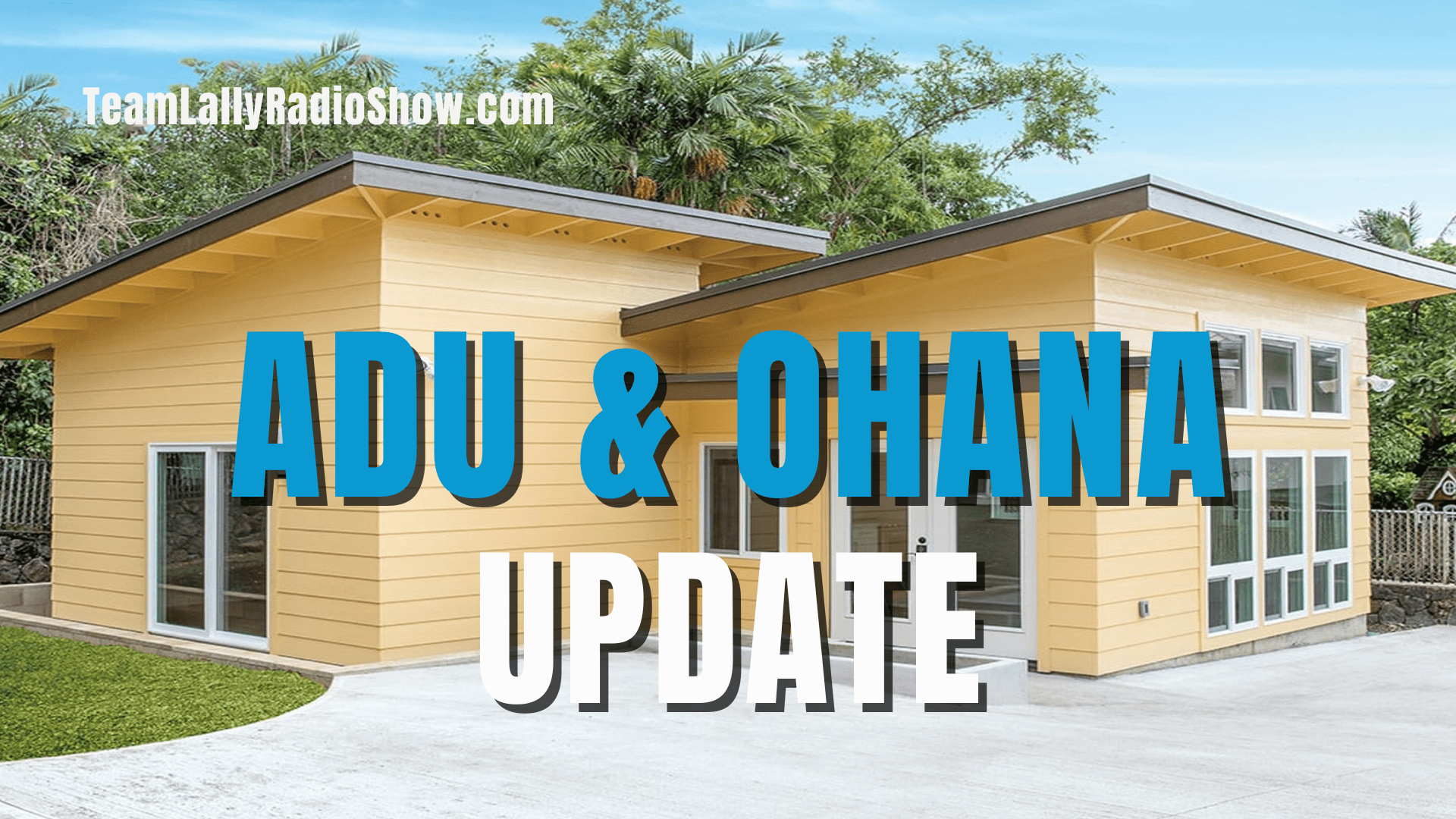
This week on the Team Lally Real Estate Radio Show, we interview Janyce Myrland of Dream House Drafting, Inc. Janyce breaks down the newest bill and ordinance shaping Oahu’s ADU and Ohana unit development—what the rules are, what homeowners must understand, and how to stay compliant. She explains key differences between ADUs and Ohana units, why Ohana units require related occupants, and why meeting all development standards is critical. Janyce also shares real-world challenges, including a cautionary story of costly fines resulting from unpermitted work.
In Experts We Trust, we have Danny Langerman of DHA Financial, LLC unpacks the concept of the 50-year mortgage. Danny walks through its potential benefits and drawbacks, why banks may hesitate to adopt it, and the importance of refinancing strategically. Adrienne and Attilio offer alternative viewpoints, including using buy-downs and temporary buy-downs to create affordability without extending loan terms.
Watch or Listen to the full episode
Ready To Find Out How Much Your Home Is Worth?
Janyce is the President and Lead Designer of Dream House Drafting, Inc., bringing together technical precision and creative vision in every project she leads. With a strong foundation in Design and Drafting Technology from New York City College of Technology, she has spent years helping homeowners translate ideas into buildable, permit-ready plans. From ADUs and ʻohana units to full remodels and new construction, Janyce is known for guiding clients through complex design and permitting processes while keeping their lifestyle, goals, and long-term plans front and center.
Dream House Drafting, Inc. specializes in residential design and drafting services tailored to Hawaiʻi’s unique building requirements. The firm supports homeowners, investors, and builders with everything from conceptual design and architectural drafting to permit submittals and revisions, helping projects move forward smoothly and efficiently. With a strong emphasis on clarity, compliance, and thoughtful design, Dream House Drafting serves as a trusted partner for turning visions into well-planned, build-ready realities.
To reach Janyce Myrland, you may contact her in the following ways:
Phone: (808) 206-7107
Email: [email protected]
Website: dreamhousedrafting.com
Interview Transcription
ADRIENNE:
Welcome back, and thanks for listening to the Team Lally real estate show, home of the guaranteed school program, or we’ll buy it. I’m Adrienne and I’m still Attilio, and if you have any questions, just give us a call at 7999596, or check us out online at Team lally.com
ATTILIO:
Our guest today is the president and lead designer at Dream House drafting incorporated with a strong foundation in design and drafting technology from New York City College of Technology, she brings both technical expertise and creative vision to every project she touches,
ADRIENNE:
from ADUs and Ohana units to full remodels and new build, she has helped countless homeowners navigate permitting design challenges and The path to turning an idea into a completed plan. Her passion ensuring every client gets a space that truly fits their lifestyle and goals. Please welcome back our guest, Janyce Myrland welcome. Janyce. Hi, Janyce, yes, we had reached out to you because we saw some some stuff that was happening, some things I post on social media that have been changing. And we were like, you know, is that true? Yeah. And you’re like, well, there are some things that have been changing. Um, so let me go a little let’s dive a little deeper. Yeah, I said, Let’s have our our listeners hear about these changes. And what is important to
ATTILIO:
know this is regarding ADUs and Ohana units. So what? What would you like to update the the listeners on regarding those kind of rule changes?
JANYCE:
Okay, I have the new bill and ordinance open on my large screen in front of you for reference. Um, yeah, I think the most important thing that people need to understand the overarching blanket is that both ADUs and Ohana units are a concession. I should say that allows people to have more than one dwelling units on a lot that normally would not be allowed to have more than one dwelling unit. So there’s obviously been a lot of excitement, because Big Island was first to say they were going to allow more than one Adu, and people were hoping that would come here, the ordinance is very specific. You can only have one adu. It has not changed, okay, yeah, the difference
ADRIENNE:
now, Janyce, what if? What if the lot has like, 10,000 square feet? Can you have two ADUs if the lot size is larger?
ATTILIO:
No, no. I looked it up. Janyce is gonna keep doing this. Oh, Janyce is gonna lead, steer us all straight. Hey, thank you, Janice. What she’s saying, and I’ll repeat this, folks, she cannot have more than one adu on your property, but she’s going to give you the rest of the story.
JANYCE:
Yes, yes, because you live in Honolulu County, if you’re listening, from Hawaii County or another county, these rules are not necessarily the same. So here on Oahu, which is considered Honolulu County, and which DPP controls. You may have one and only one adu. The good news is, especially for designers like myself, is that we are no longer limited to 800 square feet for the Adu, if someone has at least 5000 square feet on their lot, the adu can be up to 1000 square feet, one of the major challenges that you encounter in Designing for people and trying to give them workable, livable space with storage and decent sized rooms. I’m a tall person, so you know, I don’t like crampy rooms. Is that the 800 the used to be 800 square feet. Now 1000 square feet had to do with everything that the ad that was used by the accessory dwelling unit. So if you decided to put an accessory dwelling unit up on a second floor, then the stairs to get up there counted as. Was part of your square footage for that eight so, you know, if you made it a decent three and a half foot wide step, and it had to climb nine feet, you know, you’ve lost all of that square footage, plus whatever size landing you wanted. They cannot have that now inside of their living space. So with the 1000 square feet more, ADUs will be able to have lanais if they’re on a second floor. You know, it’ll just be a nicer overall experience where it’s
ATTILIO:
spread out little bit. Grandma can spread out a little bit. And you
JANYCE:
know, you’re not sitting her up to the second floor, are you?
ADRIENNE:
No, grandma is not going on. I mean, every grandma, yeah, fit grandma. You know, here’s what I would tell you, having stairs when you’re older, like, I think it helps keep you in shape.
ATTILIO:
They’ve actually proven this in Okinawa, where the centenarians, there’s a high concentration, no chairs and no no no lift chairs on the stairs they go.
ADRIENNE:
And we had, we had actually visited with one of our 95 year old clients, yeah, and he’s actually going to be 96 this, really, though, double really, but he would go right up the stairs.
ATTILIO:
That’s interesting, too, that you mentioned with the stairs. Now, what about you’ve helped people understand the difference between Ohana unit and the adu.
JANYCE:
Okay, the law has stipulated since about 1992 there are a few older ones that may not, may not apply to that Ohana units were strictly limited to people. I will read it directly. It must be identified by persons who are related by blood, adoption, guardianship, marriage, or other duly authorized custodial relationship to the family residing in the principal dwelling unit. So Ohana is an able to release some, always extras. There’s always a main, principal dwelling unit, and the Ohana requires that the occupants be people who are related to the owner related.
ADRIENNE:
Let’s see. Let’s see you have a 10,000 square foot lot, and you have some relatives that you want to have an ohana dwelling for, and then you feel like you want to have a an adu for some non relatives. Can we do that?
JANYCE:
You can do that, so long as all of the development standards for that particular zoning lot are met.
ATTILIO:
Yeah, I think, you know, the big thing that I remember Janyce, you always mentioned, and this is, I’m just gonna be straight out for our listeners. I’m gonna tell you, this is the main reason why you want to call Janice if you’re thinking about doing something like this. Because I think the a lot of times. And tell me, if you get these people coming to you after the fact they do it, I you know, I’ll make the Hawaiian version of this phrase, the okole backwards, where they hire the contractor, put the deposits down, and then find out, like, Oops, we can’t do it. So can they call you and say we’re thinking about, do this, pay some consultative fee and say, Do you think it’s possible before we start guns a blazing, bringing in the contractors tearing up the house?
JANYCE:
Definitely they can. I have, you know, always offered to realtors a design Console service for their buyers, yeah, but I can certainly do that for homeowners in general, who already own the property, to say, what are the limits of what you can and cannot do? Because among the design development standards, there’s a long list. There’s setbacks, parking, maximum lot coverage, also known as building area. There’s the maximum allowable hardscape. You also have height limits, and even, thanks to the drama that went around because of all those monster homes, is bathroom quantity limits. So there’s a lot of things that have to be taken into consideration. And then, if you can fit everything you know on the lot, check all the boxes, and you also cannot forget that both ADUs and ohanas are not automatically granted to you? Yes, there is a process.
ATTILIO:
Yeah, okay, tell me about the pre check. Tell us about so the
JANYCE:
pre check is goes right back to the fact that these two types of units are basically a concession the city is allowing where you’re going to be able to have. Have an extra unit where the zoning law says you should not and in order to make sure this works, the pre checks are reviewed by the building department, in some cases, the fire department, in all cases, the Board of Water Supply and the wastewater department, the and the traffic department, because they’re making sure that this is going to work. The most frequently denied pre checks are in areas where wastewater says we have inadequate sewer capacity, and if any one of the line items on a pre check is denied. The project is not happening. Yeah.
ADRIENNE:
So what if it is like, not attached to the sewer, and they’re using septic? How does that work? Janyce, the
JANYCE:
way that works is, then you have to have the appropriate engineer calculate how many you know, how large your leech feel has to be, how large the tank has to be. I have not seen any changes in the health department’s rules. The health department states that the maximum sized septic system that they will allow is for a five bedroom system. So now five bedrooms. So now if you’ve got enough land to where maybe you can have, you know, and Ohana and a main principle, enough surface area system, and you’ve got enough space to perhaps have another system for your Adu, then that would work, but you get into big trouble if you do not have the appropriate space for the leech field and also the appropriate setbacks. I always laugh about that, because I think I’ve only seen on one of those DIY TV shows where somebody actually built something around the perimeter of the leach field to prevent anything from going anywhere. But there are required setbacks from structures and property lines for the leech field. So there’s always this long list of criteria that you need to fit into before you can do your project.
ATTILIO:
Janyce, the question I have for you, you know, a lot of times we’re representing buyers on properties, and then we go in and do the, you know, we just, we have the property detail that we can get through through realist in the MLS. And first thing, you know, as part of our due diligence in helping either the seller or the buyers, we go to the permit section and it’ll say, like, permit open, permit closed, things like that. How trustworthy is that information in the MLS for whether permits are open or closed? Because my definitive, my definitive advice to everybody is just hire you to double check it. Okay?
JANYCE:
Well, I would, I cannot speak for the MLS. It’s something that I will personally in my business, both providing permit compliance inspection services and doing design, find very useful to have access to. But realistically speaking, I’m not a licensed Realtor, so I don’t have access. However, good answer the building department is where you can find out if permits are open or closed by definition. Unfortunately, I’ve seen this too many times. People see what is an actuality a building permit application in the city’s website, and they come and tell me, yes, there is a permit, and no, that’s only an application. It was not completely reviewed and did not become a building permit. And once it becomes a building permit, then it is quote, unquote, open only after all buildings, electrical, plumbing, and whatever other inspectors are assigned have actually put their signatures on there. Is it closed?
ATTILIO:
Is it closed? One of the things that we you know we because we’ve known you for many years, and one of the things that we find is that I think what’s valuable about your permit check is that what is physically there may not be in alignment with what DPP has recorded down there as permitted structures or additions or whatever. How can.
ADRIENNE:
I mean, then I would also say that if you’re thinking about making some updates or upgrades and getting a permit, you could be inadvertently getting yourself in hot water, right, right. Janyce, when they come out and they they come to
ATTILIO:
just the blinders on and look at what they’re what you’re calling them out for, they’re looking at everything. Oh, what about that? Well, that’s not showing it over here on our talks,
JANYCE:
but I’m trying to explain to people, and I find myself going through this repeatedly all the time of late, with new clients, explaining them to them what it is like to be an architectural designer, a building inspector, a general contractor, and even though I’m only one of those two and have never been the other two, we all get a feeling when we read a certain plant. We have an idea when we arrive if things look different, we’re like, wait a minute, what’s the deal? Am I in the right place? Yeah, I’m in the right place. Well, something’s wrong, they can feel that off. Size wise, they can feel they can definitely be off, you know, in terms of where things are laid out. It’s, it’s not something that you just breeze through and don’t notice. It’s something that grabs you. If you work in those Washington,
ATTILIO:
yeah, with your permit check, you’re coming to the property, and you’re walking through and making sure that there’s you’re basically like, I mean, is it in a sentence? Is it you’re basically looking for anything that’s not permitted on within confirming, yeah, confirming that what’s whether it’s permitted is matching up to what’s in reality is there,
ADRIENNE:
so you don’t get caught by the permit inspector when you’re wanting to do the work, right, right? So, Janyce, maybe you could share us. Share a story of anything the most. Give it. Give it to us, because they need to know these things. You’re the most funniest one. Yeah. Give it to us anyway.
JANYCE:
Okay, so first of all, people really need to know that, whereas you guys, remember, we worked on a project that was a REO property, and you were trying to, you know, get it permitted for sale, and in actuality, the bank, after retaining me and we got the permit, decided to just sell the loan, and you guys were cut out. Okay, remember that one? Yeah, but on that one, it was, you know, close to $150,000 in fines had been already, yeah, um, come up line or whatever. Then, um, there was definitely needed repairs which hadn’t been done, but the bank decided to just, you know, get out of No, it does is, so people need to realize what happens is, if you don’t understand what’s going on, and you think, oh, there’s a permit, because your real estate professional says so, which is what happened to the alternate buyer. And he even went so far as to tell them that the only problem with it was that it didn’t have a permit. Now it does, and despite my efforts and my former business partners efforts to get in touch with her and say, hey, you know, this permit belongs to whoever buys it, we’d like to give it to them, and we’d also like to alert them to the fact that it’s open because none of the repairs have been done, and she was excessively rude, and then eventually, the buyer wanted to know why their permits were open when they after they had closed on it, and she ended up running out of the country because we had covered ourselves. I wrote a very specific letter to her broker in charge and inform them. You know, here we’re trying to help whoever buys this from you guys. And this is this the situation. And then there have been others where people have moved in and the neighbors have called it is extremely important for people to understand that if DPP gets a complaint, they are obligated to come out and check it out. And there’s no way to know, you know who’s gonna say anything, if anybody’s gonna say anything. But unfortunately, I have met up with far too many people who have only been in their place for a month or less, and they have a notice of violation. They haven’t done any construction, they just bought it. And the fees are no longer so tiny anymore. They start at $50 a day, and there’s a tripling of the building permit fee as an added penalty. So the five. Finds $50 a day.
ADRIENNE:
Sure, what’s the largest one that you’ve ever seen? Janyce, as far as like the fines and the fees.
JANYCE:
I didn’t get to see it personally, but I had somebody calling me because they should have known better. They were house flipper, and they decided to keep a particular property. And they were actually, DPP is using a collection agency a lot now, and they were trying to foreclose on this person. So it was, you know, significantly above the 140 150 from the one that we had worked together on which you guys
ATTILIO:
now, they’ll DPP will work with you, right? I mean, if you’re compliant and cooperating, they’re going to work with you on that.
ADRIENNE:
I would say, unless you’re a repeat offender, you’ve seen the repeat offenders are not working with them.
JANYCE:
Now I’ve seen the fuse. It is not as easy as it used to be, especially now that the collection agency is involved, yeah, so unfortunately, sometimes there’s nastiness between neighbors. I did have one client who was he did have something that he had done that was not permitted, but what he was reported on was not true, and even though, but he had to deal with the one inspector said, Oh, I see what you mean. And then remove the violation. When the inspectors changed, who had what area that person got the same violation over again. And then, you know, that was during the time when it was taking DPP so long to get the permits, so fines were mounting up, and he had to really battle with them to say, wait a minute, that was removed. Why am I now? You know, being charged fines on it. But the problem is, is you’re talking to a collection agency, and they don’t usually negotiate, because by time something goes there, it’s understood that the old party has given up. So yeah,
ADRIENNE:
so lesson lesson learned. Just do it right from the beginning. Be nice to your neighbors. Be a good neighbor. Do it right from the beginning. Call Janyce. Janyce Myrland, Dream House drafting. She will help you navigate all things, permits, all things. ADUs Ohana dwellings, aging in place. Yeah. I mean anything that you want to do with your home. She can do it
ATTILIO:
well, going back to the new rule changes regarding the ADUs. Any final comments that you want to share with our listeners before we wrap it up?
JANYCE:
No, I just wanted to make sure that they understood that this is not just an easy thing that you just drop into. There are a lot of boxes to be checked off.
ATTILIO:
And yeah, I think people, yeah, they see something on social media, and they get all excited about it, and there’s no detail there. There’s no research.
JANYCE:
Well, not everybody wants to hear that. Some people love, you know, folklore and smart legend. And they just,
ADRIENNE:
I would hate to like, if you are currently, like, looking to buy a home and have that home add, like, the adu or Ohana dwelling, or maybe you’re a listing agent and you want to know, like, Is this possible to add an adu? Reach out to Janyce, you know she’s going to let you know you don’t want to get in hot water with advising clients or advertising something that’s not completely true. Yeah. So check with Janice. She’s the expert.
ATTILIO:
If you’re somebody looking to buy a home, or you’re representing a buyer, I would highly recommend that, you know, especially if it’s, it’s, you know, one of these homes in the older neighborhoods with a lot of obvious like, you look at it visually, and you’re like, there’s a lot of work that’s been done to this home. Probably want to bring Janice into to because I always say, you know, Janyce is what I tell agents and buyer agents, you don’t want to inherit somebody else’s problems.
ADRIENNE:
The time to negotiate is in the beginning, like, after it’s closed, like, I mean, then it becomes, you know, you’re gonna be like, well, or litigation. Yeah, right.
ATTILIO:
And I think Janyce, you mentioned it earlier too. I was at a broker meeting, and the director of the Department of Planning was there at the time, and he said, You know, there’s no DPP police, it’s your neighbors that are turning you in. So and then he said, like, there’s a huge chunk of the properties on Oahu that have non permitted work on them, that’s just what it is. But they’re not running around looking for it, right? It’s usually somebody’s throwing you in
JANYCE:
resources to run around looking for it. One of the things that I see consistently when I do a permit checkup inspection, where we actually pull all the permits from whenever the property was first built, when you look at the ones from the 40s. In the 50s and even some of the 60s, you will see where there were inspections, where building inspectors were going door to door and checking on homes. They don’t have the staff to be doing that anymore, so it’s very hard.
ATTILIO:
Yeah, all righty, well,
ADRIENNE:
thank thank you, Janyce, for being a guest on our show and informing our listeners and and also, like always helping our team. Thanks for the invite a expert. Yeah, you’re amazing expert. We trust and we love having you, having you as a resource for us, our clients and our listeners. Yes, thank you so much, Janice. Thank you. Take care. All right, so that’s Janyce Myrland, Dream House drafting. You can find out all about Janyce by going to Team lally.com go on to the resource tab and select experts. We trust. She’s right there. You can click on her website all sorts of useful information.
Follow Us On Social Media
Looking For A Home in Hawaii?

Team Lally Is Hiring Real Estate Agents in Honolulu
We focus on long-term growth, not just...
How Top Agents Deliver Five-Star Client Experiences in Hawaii
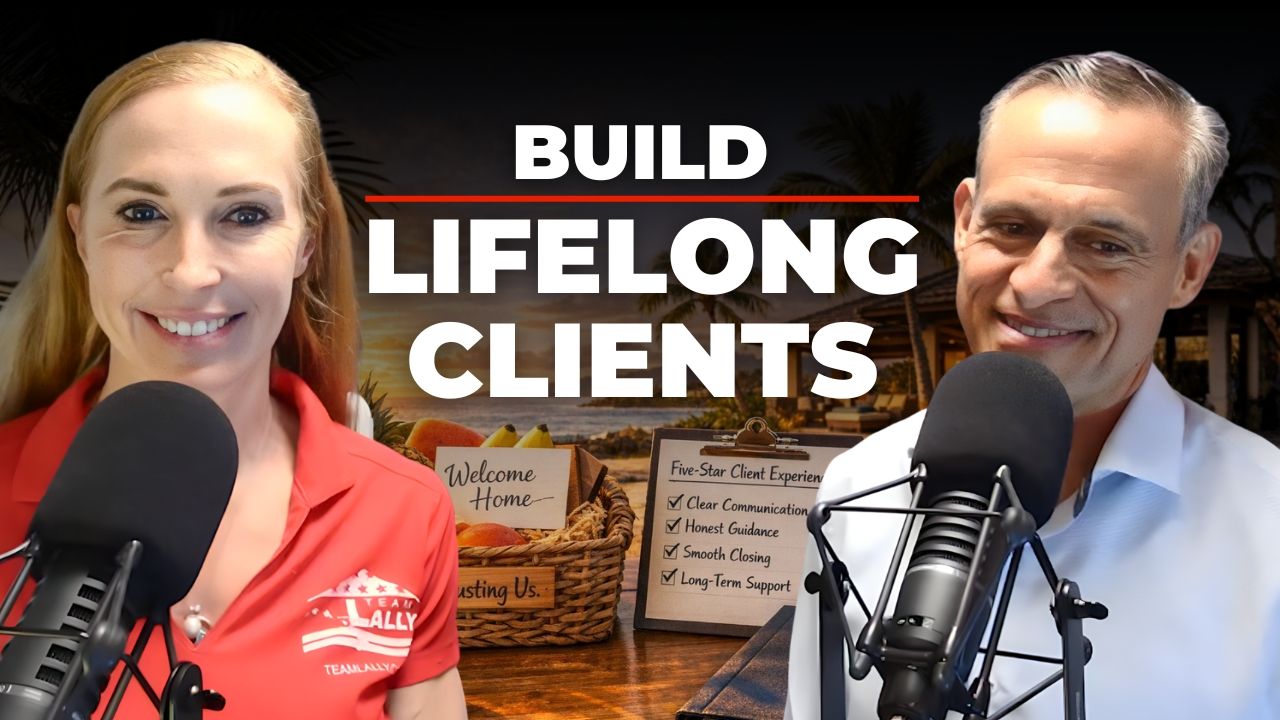
How do you know you can trust your agent long after closing? Real estate is about more than just closing deals. The best agents understand that relationships built today can last for decades. Trust, care, and authentic guidance create five-star client experiences. If you want to know what really goes on behind long-term client relationships in real estate, check this out.